Introduction

Unmanned Aerial Vehicles (UAVs) have seen increasing use in recent years [1]. 

One commonly used type of aircraft is the remote-controlled multi-copter, often referred to as a 'drone'. These vehicles can perform a variety of tasks that are dangerous or difficult to accomplish by other means. 

For example, they can be used for crowd observation in conflict management by law enforcement, or for surveying forests and other areas that are difficult to access by land [2]. Therefore, it is crucial to have a robust system in place that can intercept and navigate around dangerous obstacles such as trees, other drones, or approaching objects [3]. 

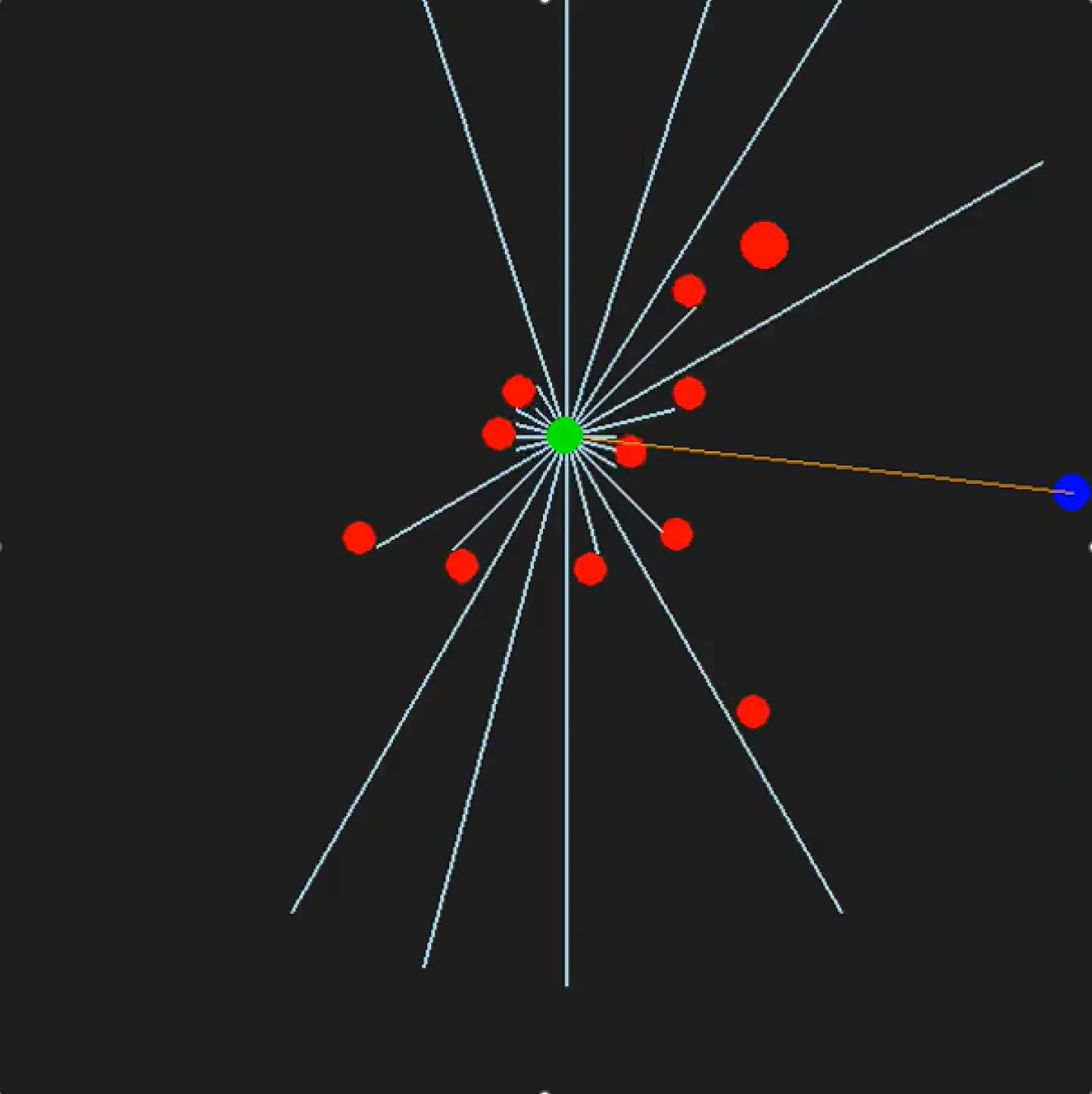
This project aims to solves this problem by utilizing Reinforcement Learning (RL) and a LiDAR Sensor. A RL Algorithm trained in simulation is capable to adapt to a multitude of unseen scenarios, while a LiDAR Sensor provides a dense scan of its surroundings, allowing for 360° surveillance.
Research Gaps

  • Lacking publications on dynamic intruder avoidance
  • No distinction between path planning and obstacle avoidance
  • 3D Pointcloud LiDAR Data in an End-to-End approach is missing
  • Low fidelity Simulation Environments lead to lackluster real-world performance
  • No Quantitative Evaluation of Experiments
  • Missing coherency in algorithm development
  • Absence of Domain Randomization to train robust agents

Goal

This project will fill the research gaps with the following:

  • Treating the dynamic intruder avoidance problem as a stand alone challenge detached from path finding.
  • Creating the state space directly from LiDAR reading and developing a End-to-End approach
  • Utilizing high fidelity simulation environments
  • Deploying quantitative evaluation to measure progress in a scientific way
  • Developing and testing new algorithms under consistent experimental conditions
  • Applying best practice in RL development to create robust Agents

References:

[1] Lizotte, Katherine. Faa aerospace forecast fy 2018-2038.

[2] Alana Saulnier and Scott N. Thompson. Police uav use: institutional realities and public perceptions. Policing: An International Journal of Police Strategies & Management, 39(4):680{693, 2016.

[3] J. Tang, S. Lao, and Y. Wan. Systematic review of collision-avoidance approaches for unmanned aerial vehicles. IEEE Systems Journal, 16(3):4356{4367, 2022.

Additional projects on Unmanned Flight Systems and Urban Air Mobility can also be found at the Technology Transfer Center (TTZ) "Unmanned Aerial Systems."