Solar Thermal Agriculture with bifacial collectors for farming synergies
The STRAWBERRIES project is developing the world’s first agri-solar thermal system. This integration makes it possible to generate solar energy on the same field while maintaining its agricultural usability. The Institute of new Energy Systems of Technische Hochschule Ingolstadt is coordinating with European partners from industry and research to develop an innovative system concept based on newly developed insulated glass collectors. A key milestone of the project is the construction and commissioning of a pilot plant, which will enable the acquisition of real-world measurement data.
Research Project STRAWBERRIES – innovative Agri-solar thermal technology for a sustainable and space-efficient heat supply
What is agri-solar thermal energy?
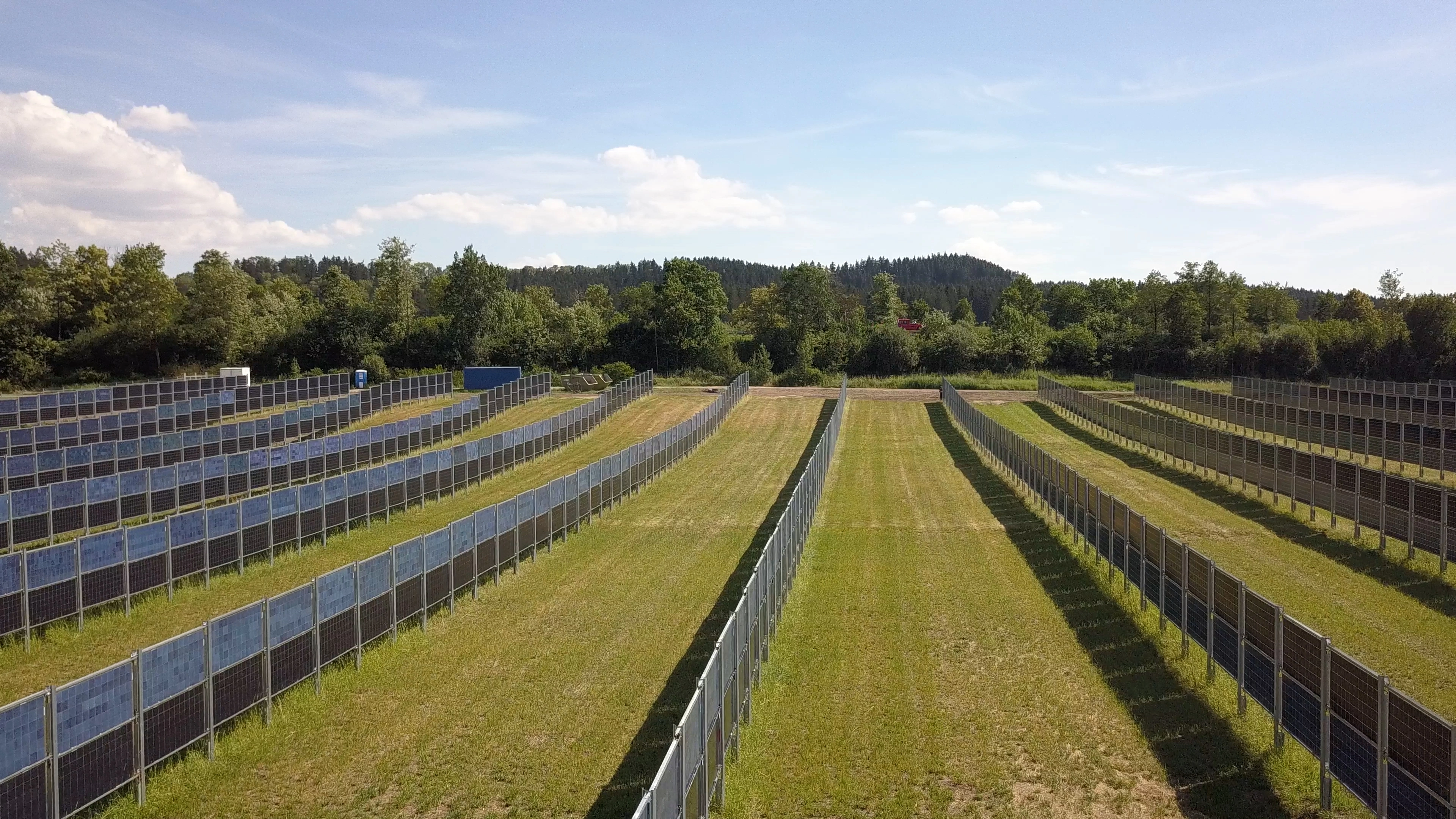
As the large-scale use of solar energy on open land continues to develop, the competition for land use between solar energy generation and agricultural use is increasingly coming into focus. While so-called agri-photovoltaic (Agri-PV) systems have already been developed and successfully implemented in the field of photovoltaics, a solar thermal implementation of this bifacial system concept has so far not existed.
With this in mind, the Institute of New Energy Systems (InES) of the Technische Hochschule Ingolstadt is collaborating with European partners to develop the world’s first bifacial, vertically mounted agri-solar thermal system.
This new system enables highly space-efficient solar heat generation while still allowing for the use of land for agriculture.

Technical basics - foundation

The system design is based on highly efficient insulated glass flat plate collectors, which were also developed by the Technische Hochschule Ingolstadt.
In these collectors, a highly selective coated absorber is embedded between two glass panels. A hermetically sealed housing allows for the use of a noble gas for thermal insulation.
The collector’s transparency on both sides enables thermal utilization of the rear side (bifaciality) and therefore forms the basis for the STRAWBERRIES project.
Pilot facility in Bavaria

In addition to simulation-based design and system calculations, a key component of the project is the construction and integration of a pilot plant into a local heating network. To this end, a test facility with approximately 93 m² of collector area will be built near Moosburg an der Isar in the summer of 2026. In the first phase, the facility will be constructed with three parallel rows of collectors. Each row will be equipped with eight vertically mounted, double-sided insulated glass collectors, resulting in a total of 24 insulated glass collectors being installed.

(1) material development: development of a bifacial, thermochromic coating for the collectors
(2) collector and system design: development and scientific analysis of a innovative system that enables bifacial operation
(3) concept and hydraulic integration: translating the specific requirements of agrisolar thermal systems into a adapted design concept for the collectors and the system hydraulics
(4) structure and layout: development and experimental testing of a new mounting system for the vertical installation of collectors
(5) practical demonstration: design, installation, and metrological analysis of a functional Agri-ST pilot plant
Citrin Solar is the project’s main industrial partner and is responsible for the practical implementation and installation of the pilot plant. In addition to this installation, Citrin Solar will also carry out the integration into an existing local heating network. This will enable the theoretical system concepts developed by the Institute for New Energy Systems to be translated into real-world plant operations.

As an academic partner, the University of Minho (Portugal) is responsible for the materials science development of the innovative collector coatings. The research centre is focusing on the bifacial absorber in order to achieve maximum solar heat absorption with minimal radiation losses. This innovation makes a significant contribution to the efficiency and longevity of the innovative insulated glass collectors and, consequently, to the entire agri-solar thermal system.
Funding Agencies
This project is funded by the Federal Ministry for Economic Affairs and Energy (BMWE) of the Federal Republic of Germany under the project ID 03EN6041A as part of the 7th Energy Research Programme. The project has been funded by partners of the CETPartnership (https://cetpartnership.eu/) through the Joint Call 2022. As such, this project has received funding from the European Union's Horizon Europe research and innovation programme under grant agreement no. 101069750.


Partner
Coordinator:Technische Hochschule Ingolstadt / Institut of new Energy Systeme (InES)
Citrin Solar GmbH Energie- und Umwelttechnik
Universidade do Minho, Physics Centre of Minho and Porto Universities
Relevant Publications
Towards maximum cost-effectiveness: multi-objective design optimisation of insulating glass flat-plate collectors (2025)
Messtechnische und simulative Untersuchung eines Isolierglaskollektors in einem solarthermischen Kollektorfeld auf Optimierungspotentiale (2025)
Isolierglaskollektoren und Nahwärmenetze: Analyse des Betriebs und Herausforderungen bei der Integration (2024)
Effect of argon concentration on thermal efficiency of gas-filled insulating glass flat-plate (2023)
Agri Solar Thermal Systems: A Brief Study on the Energetic Potential of Bifacial Solar Thermal Systems (2022)
Entwicklung eines Großflächenkollektors in Isolierglasbauweise für den Einsatz in Wärmenetzen (2020)
![[Translate to English:] Logo Akkreditierungsrat: Systemakkreditiert](/fileadmin/_processed_/2/8/csm_AR-Siegel_Systemakkreditierung_bc4ea3377d.webp)