Because this engine is more than just an exhibit. It symbolises a development that began on a farm in the Upper Palatinate. Even as a child, König preferred to hold tools in his hands rather than toys. While others played outside, he stood between Unimogs and tractors with a screwdriver and a watchful eye. His father was a farmer, collector, and tinkerer. The workshop: a place of trial and error, disassembly, and understanding. "I just grew into it," says König, looking back. "It was completely normal to take things apart and put them back together again." This influence is still felt today. "It helps to be a bit pedantic," he says - referring to the mixture of precision, patience, and tenacity that is essential in aviation. After secondary school and technical college, he began his mechanical engineering studies at the THI. This is where his interest sharpens: Curiosity turned into a fascination for aviation. The systems become more complex, the requirements increase, and the consequences of errors are serious. "You quickly realise that there is no room for inaccuracy." His doctorate in lightweight construction under Professor Jörg Kessler, carried out in cooperation with the University of the Federal Armed Forces in Munich, was a formative stage. It was here that it became clear just how specialised aviation is. This was followed by a move to Rolls-Royce Deutschland Ltd. & Co. KG in Berlin: modification support, detailed work, maximum precision. "You familiarise yourself with details that are crucial in the end. You have to like that." König later travelled to Wichita, Kansas, in the USA for Rolls-Royce and worked for a module supplier on thrust reversers - a safety-critical system that slows down aircraft after landing. In 2011, he returned to Ingolstadt - as a professor, with a clear idea of what teaching should look like: clear, tangible, close to practice. "You can explain a lot," he says, "but you only really understand how it works when you see it." The engine in the G-building is an expression of precisely this attitude: a Rolls-Royce Pearl 700, a state-of-the-art pre-series flight test engine, weighing several tonnes and originally used for flight testing. The fact that it is now in Ingolstadt is anything but a matter of course. For a long time, König himself doubted whether such a project could be realised. He developed and tested the construction that supports the weight on his own farm, where it all began. Today, the engine is an integral part of academic studies: students gather around it, look inside, and ask questions. What would otherwise remain hidden becomes visible; technology loses its abstraction. "You notice immediately when the spark is lit," says König. "When questions suddenly come up, when someone wants to go deeper." It is now also open to the public. It attracts visitors and has become a point of identification for Aeronautical Engineering at THI - a field of study that has developed dynamically over the past 15 years and is now more in demand than ever. When König talks about it, the enthusiasm is palpable - and infectious. It is transferred to students and colleagues. And at home too: his son Georg is already happy to be involved. "He's already in the thick of it, too," says König and smiles. |
A giant on campus: How the "Pearl 700" engine came to Technische Hochschule Ingolstadt (THI)
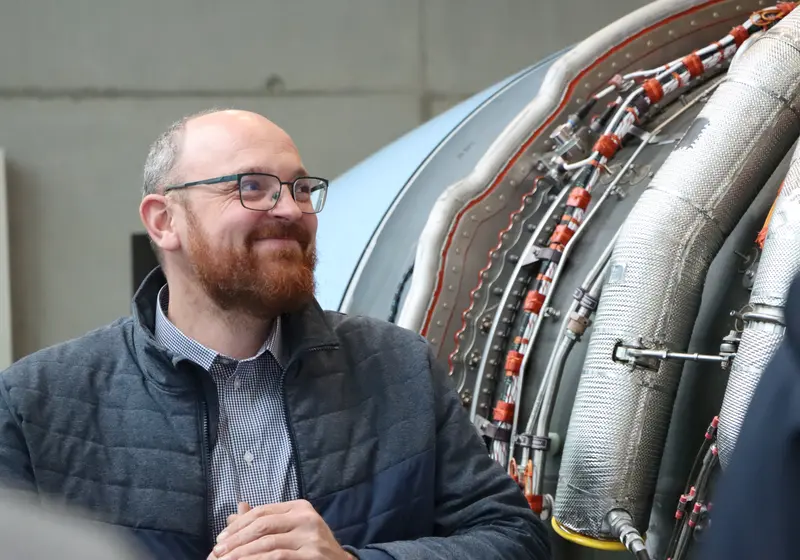
An impressive teaching exhibit: Professor Ludwig König in front of the flight test engine in the G Building at THI (Photo: THI).
![[Translate to English:] Logo Akkreditierungsrat: Systemakkreditiert](/fileadmin/_processed_/2/8/csm_AR-Siegel_Systemakkreditierung_bc4ea3377d.webp)